Lawns and sod
A layer to lay sod or seed on.

Materials
Mostly sand, some silt and clay. Sold by the ton out of Hutto.
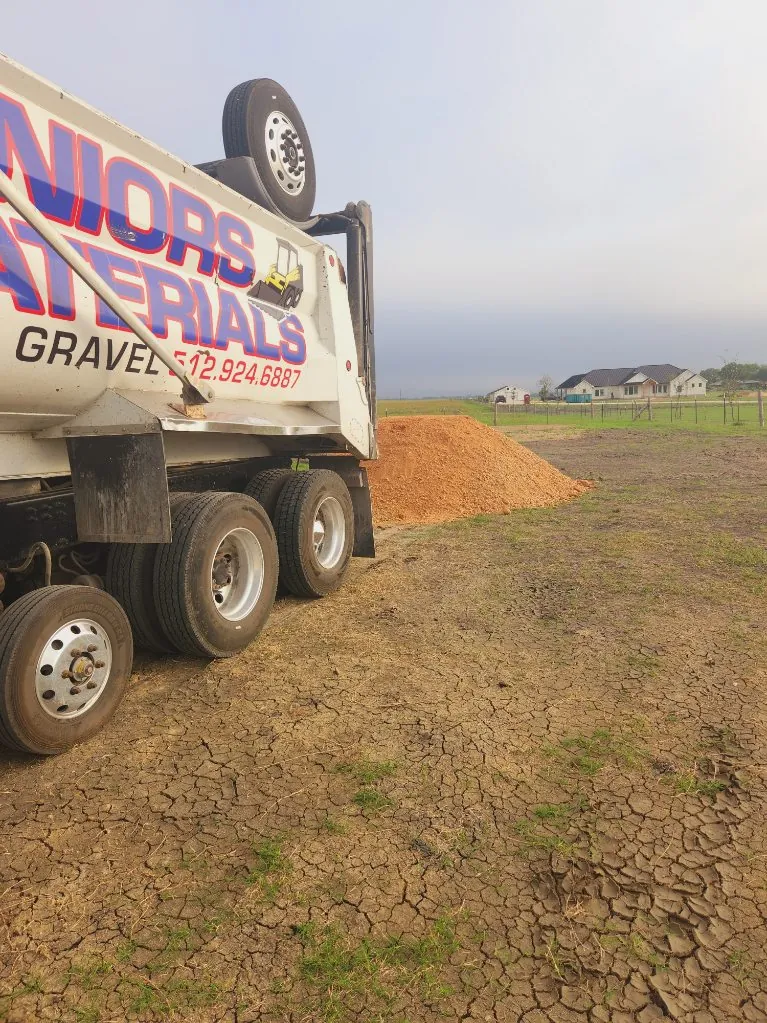
A layer to lay sod or seed on.
Fills dips and evens out low spots.
Fills raised beds and planting areas.
Fill under slabs when the spec allows.
Backfill and building up ground.
Horse owners order it from us.
Mostly sand, with less than 20% clay[1].
FEEL
Weak ball
Loose when dry. Damp, it squeezes into a ball that breaks apart easily, not slick like clay[4].
DRAINAGE
1.8 in per ft
Water it holds for plants, against 2.1 for loam and 0.5 for sand[3]. Plan to water more often[5].
NUTRIENTS
CEC 2 to 15
Its nutrient holding power, against 25 to 60 for clay[3]. Water can carry nutrients below the roots[5].
Set the area and the depth. You get cubic yards and about how many of our trucks that fills. We sell by the ton, so text us the yards and we’ll convert it for your load.
YOU NEED ABOUT
0 cubic yards
Ballpark only. Moisture and how it settles change the final amount.
Builders use it as fill under slabs and pads, and we deliver it for that. The fill spec comes from your builder or engineer, so check it with them before you order.
Need the pad built too? Our site and pad prep crew grades the site and builds it up with fill and road base.
Sandy soil dries out faster, so drought tolerance matters most. Here’s how Texas A&M rates the common lawn grasses[6].
| Grass | Drought | Shade |
|---|---|---|
| Bermudagrass | Very tolerant, takes traffic | Needs full sun |
| Buffalograss | Best where rain is 25 inches a year or less | Full sun, little shade |
| Zoysia | Tolerant, browns sooner in long droughts | Light to moderate shade |
| St. Augustine | Less tolerant than bermuda or zoysia | Handles the most shade |
“Their sandy loam was of excellent quality, and they offered a great price. The delivery was prompt, and their communication throughout the process was clear and efficient.”
“The Sandy loam was just what I needed for horse stalls and paddock and Juniors delivered quickly and on time! Great job.”
Lawns and sod, leveling a yard, filling garden beds, fill under pads and general backfill. It drains well and is easy to spread and work.
Builders use it as fill under slabs and pads, and we deliver it for that. Your builder or engineer sets the fill spec, so check with them before you order.
Sandy soil holds less water, so drought tolerance matters. Texas A&M calls bermudagrass very tolerant of drought, in full sun. Buffalograss does best in dry, sunny areas from Central to West Texas. Zoysia is drought tolerant and takes light shade. St. Augustine takes the most shade but handles drought less well.
Nutrients hang on to clay and organic matter. Sand has very little of that holding power, so a soil that’s mostly sand keeps fewer of them. Texas A&M lists sandy loam’s holding capacity (CEC) at 2 to 15, compared with 25 to 60 for clay.
Multiply the area in square feet by the depth in inches, divide by 12, then divide by 27. That gives cubic yards. The helper on this page does it for you. Text us the yards and we’ll turn it into tons for your load.
Dry, it’s loose and runs through your fingers. Damp, it squeezes into a weak ball that breaks apart easily and doesn’t feel slick the way clay does.
Our yard is at 168 Mustang Creek North Loop in Hutto. We deliver about 120 miles around it, including Austin, Round Rock, Georgetown and Pflugerville.
No. Compost is broken down organic matter. Sandy loam is a mineral soil made mostly of sand with some silt and clay.
Yes. There’s an 8-ton minimum charge, and a load runs up to 24 tons.
We work out of Hutto and deliver about 120 miles around it. Farther is possible if the haul is paid for. We’ve hauled as far as Amarillo and Padre Island.
Every load is priced by address.
Tell us what you need and where.